

I’m often intrigued whenever I hear about a new cooking game, only to be immediately disappointed upon seeing the gameplay. Minigames and restaurant management dominate the genre, but neither capture the true experience of cooking for me, leaving me yearning for something more ambitious.
Cooking games inherently need to abstract away some finer details. Being such a tactile thing, a lot of the directness of cooking is lost when a mouse and keyboard are between your hands and the food. Thus, it is no surprise that many games opt to simplify cooking as much as possible, often to a single press of a button.
Crafting menus are surely the simplest form of cooking in games – so long as you have the required number of ingredients, you can make a meal out of them, instantly or after a short non-interactive cutscene. Though simple, this tends to lack flexibility, as you are rarely allowed to substitute and must instead provide the exact correct ingredients – e.g. a specific fish instead of just any fish.
Games such as Overcooked utilise a somewhat less abstract method based around cooking stations. Rather than cooking a recipe in one action, ingredients are processed individually at stations, breaking down the process into steps. This allows for more flexibility for the player and enables multi-tasking.
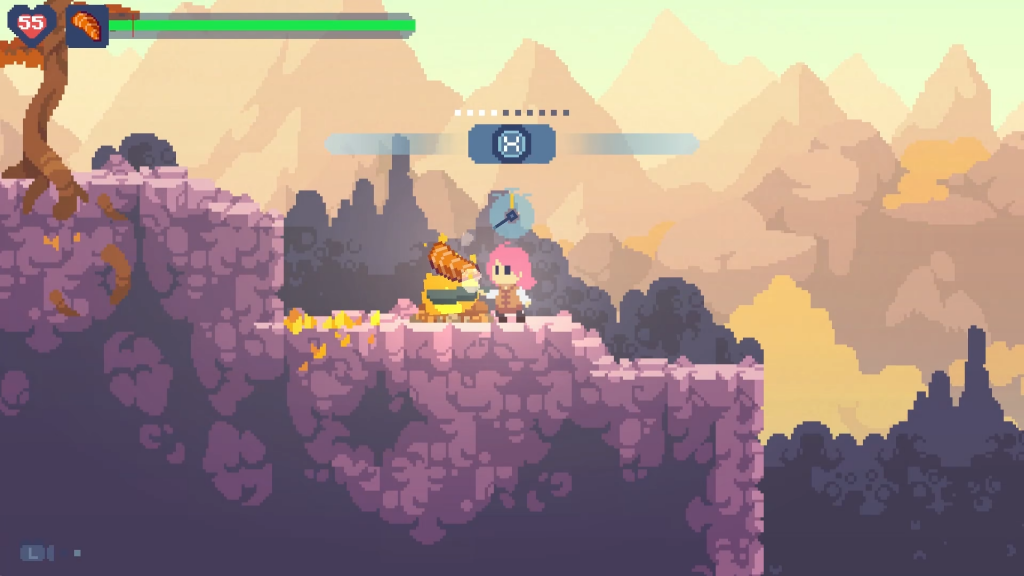
What many games opt for, however, is a collection of minigames, where the player must press buttons in time to achieve a good result. This baffles me, as it turns cooking into some sort of rhythm exercise, which has almost nothing in common with actual cooking. Unfortunately, when a game claims to be about cooking, this is what you are most likely to find within.
Restaurant management often plays a role in cooking games as well, giving them their familiar structure. The focus is on satisfying impatient customers before they leave and earning money, to buy upgrades, ingredients or hire staff. This leads to players tending towards efficiency, with little room for experimentation.
While these types of gameplay may appeal to most, I am left dissatisfied, wanting a different sort of cooking game.
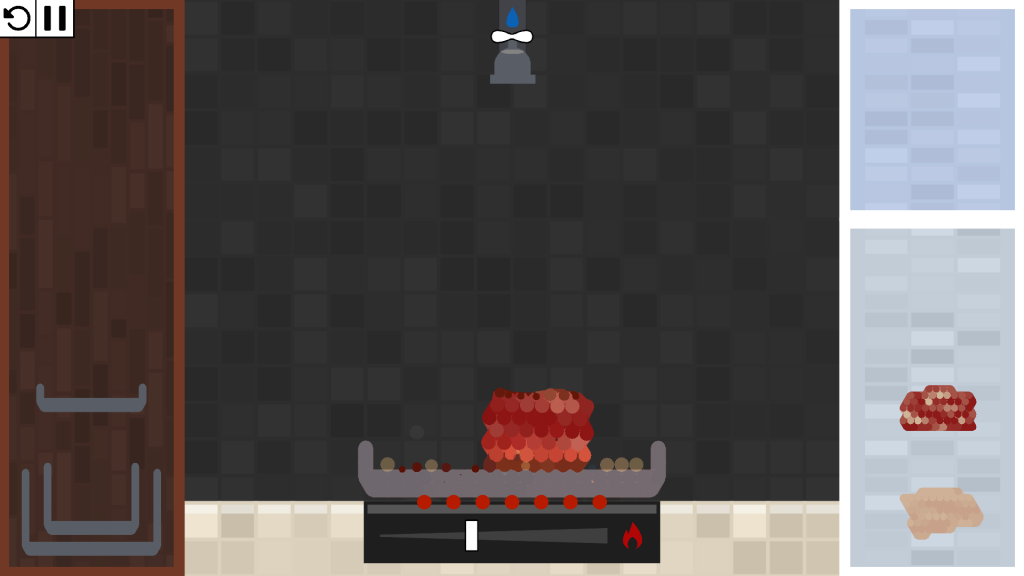
To fill this niche, I’m making my own cooking game which rejects many of these commonplace mechanics in favour of a tactile, physics-based system. While it is still early days, I have released a playable prototype of the game. If you also find yourself dissatisfied with existing cooking games, please check it out.
Leave a Reply
You must be logged in to post a comment.